|
||||||||||||||
Norman Rockwell - The Dugout
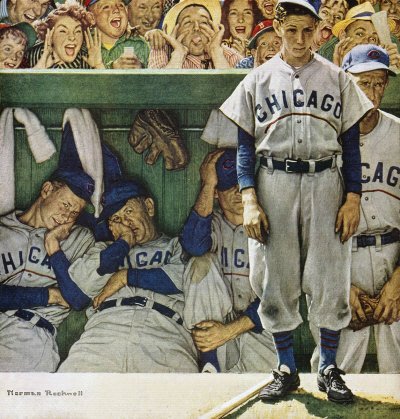
September 4, 1948 Issue of The Saturday Evening PostThis painting by Norman Rockwell, The Dugout, appeared on the cover of The Saturday Evening Post published September 4, 1948. This is yet another timeless favorite of Rockwell collectors, a classic for the ages. Another title for this painting is Chicago Cubs in Dugout. This painting was Rockwell's fifth cover for The Post in 1948. In 1948, there were a total of seven Norman Rockwell Saturday Evening Post covers published. This painting was also Rockwell's 255th overall of 332 total pictures featured on the cover of The Post. Rockwell's career with the Post spanned 47 years, from his first cover illustration, Boy With Baby Carriage in 1916 to his last, Portrait of John F. Kennedy, in 1963. I have seen pristine original copies of this magazine cover sell for over one hundred dollars on eBay. And to think it only cost ten cents originally! And it was mint condition at that time, too. The original watercolor on paper painting, 19 x 17.75 inches or 48 by 45 cm, is currently part of the collection of The Brooklyn Museum. This painting also appears in four Rockwell commentary books. It appears:
Three photographs taken during the production of this painting are reproduced in Norman Rockwell: Behind the Camera by Ron Schick on pages 112 and 113, as well as the painting. This classic Norman Rockwell painting shows the Chigago Cubs, the National League baseball team affectionately dubbed the loveable losers. The DugoutGiclee Prints on Archival Paper: This is the only one of Rockwell's Saturday Evening Post cover where the published painting was rendered in watercolor on paper. Rockwell was nearing his deadline for the assignment and realized that the oil on canvas painting he was working on would not be dry in time to meet the deadline. He abandoned the oil on canvas illustration he was working on, and, instead, turned to the faster drying watercolor medium for the painting that was published on the cover. Then he finished the oil on canvas and gave it to a friend. That oil on canvas was sold at auction in March, 2001. The opening bid was $100,000 USD. I have not yet found the amount of the closing bid for that auction. Another oil on canvas study of The Dugout was recently auctioned by Christie's in New York on December 2, 2009. That painting brought $662,500 US at the hammer. The painting expresses the anguish the Chicago Cubs were feeling during the 1948 season. The events depicted are from a double header with the Boston Braves at Boston Braves Field on May 23, 1948. The Cubs dropped both games that day, losing 5-8 the first game and 4-12 the second. At the start of the day the Cubs record was 11-15, and, at the end of the double header, their record was even worse at 11-17. I found this information at Baseball-Almanac.com. I have read opinions that this painting was what actually firmly cemented the image of Loveable Losers into the consciousness of the Chicago Cubs. We have to wonder if the Cubs management really knew what the illustration would be about. Whatever effect the painting has or has not played on Chicago Cubs' psyche over the decades since, the painting is not a flattering portrayal of the 1948 team. With this glimpse into the Cubs dugout, Norman Rockwell gives us an insight into the side of sports that most sports coverage avoids, the agony of defeat. He also shows us the ugly side of winning. First, let's talk about the agony of defeat. We can see four Chicago Cubs players and their batboy. The bat boy is actually a real bat boy. His name is Frank McNulty. He was actually the batboy for the Boston Braves, but donned a Cubs uniform to pose for the painting. Frank had a bit of a challenge getting into character for this painting. Rockwell had to really change his mood to get the facial expression he wanted. Remember Frank's team was the Braves, and they were winning. Behind the bat boy, we can see the on deck hitter. All-Star pitcher Johnny Schmitz, the next Cub at bat, looks very apprehensive and anxious. He doesn't look very confident at all. Inside the dugout, totally shielded from both the sun and the fans, we can observe the mood of three Cubs players. It is dark inside the dugout. All three look disgusted at the course of events of the game. Maybe one of them has just batted and is dejected by his performance. That attitude can certainly be catching. Seated in the middle is manager Charlie Grimm. Seated to his left is pitcher Bob Rush and to Grimm's right is Al Walker, the catcher. Some of the fans in the background also illustrate the ugly side of winning. We are not told whether the fans in the background are Braves fans or Cubs fans. We can, however, observe that a large portion of them are jeering at the Cubs that they can see, so it is safe to assume that they are being portrayed as Braves fans. In other words they are fans of the home team which is also winning. Apparently, something has just happened in the game that merits the fans' attention. From the fans' delighted expressions and the Cub player's dejected expressions, we can deduce that something bad for the Cubs has just taken place on the diamond. The Dugout was only one of 322 Norman Rockwell Saturday Evening Post covers; Here is the list of Norman Rockwell Saturday Evening Post cover illustrations.
Here is the complete list of all Norman Rockwell magazine covers. Most of the fans are jeering the on deck batter and the bat boy. A few appear to just be enjoying the turn of events in the game without rubbing salt into wounds. Rockwell often used his neighbors in paintings. I wonder how many Stockbridge natives are depicted in this group of Boston Braves fans. I have no doubt that most of Stockbridge really considered the Braves their hometown team. Some of the models identities are known. The girl farthest to the left is Helen Fitzsimmons, daughter of Braves' coach Freddie Fitzsimmons. The girl just to the left of the batboy's head is Theresa Prendergrast, wife of Jim Prendergrast, one of the Braves' pitchers. We can actually get a glimpse of Rockwell in the painting. His face appears in the upper left corner as part of the jeering crowd. So the painting is also at least partly a Norman Rockwell self-portrait. 2016 Update: No Longer Loveable LosersCongratulations, 2016 Chicago Cubs and their fans! You earned those wins. You are loveable winners now.
(Image Only) Copyright © 1948 Saturday Evening Post & Curtis Publishing Company
Remember to check back often.
|
Norman Rockwell Quotes:I'll never have enough time to paint all the pictures I'd like to. No man with a conscience can just bat out illustrations. He's got to put all his talent and feeling into them! Some people have been kind enough to call me a fine artist. I've always called myself an illustrator. I'm not sure what the difference is. All I know is that whatever type of work I do, I try to give it my very best. Art has been my life. Right from the beginning, I always strived to capture everything I saw as completely as possible. The secret to so many artists living so long is that every painting is a new adventure. So, you see, they're always looking ahead to something new and exciting. The secret is not to look back. I can take a lot of pats on the back. I love it when I get admiring letters from people. And, of course, I'd love it if the critics would notice me, too. You must first spend some time getting your model to relax. Then you'll get a natural expression. More at BrainyQuote. Rockwell Favorites
|
|||||||||||||
|
|
||||||||||||||
|
Images are copyrighted by their respective copyright holders. Graphic Files Protected by Digimarc. Contact us for details about using our articles on your website. The only requirements are an acknowledgement and a link.  
|
||||||||||||||