 |
||||||
Best-Norman-Rockwell-Art.com
|
||||||
Many questions have arisen concerning claims of copyright and licensing. Seldom does a day go by that someone doesn't contact us . The questions range from "Can I buy this..." to "May I license that..." along with many "Great site...", "Thanks for putting this on the web..." and "How did you..." included as well.
Licenses have to purchased from the license holders, not here. Also, nothing is for sale here, though I can recommend some very reputable sources.
First, Our Mission
Best-Norman-Rockwell-Art.com is striving to be the best free source for seeing what Rockwell painted.
I will not knowingly publish anything that Rockwell didn't paint. Rockwell's range of work is very broad. Publishing everything he painted could and probably will take a looong time.
Everything you see published on these pages is a scan from my collection or a friend's collection when that friend was kind enough to lend the image. These are not reprints or anthologies. These are the actual magazine covers, article illustrations, advertisements and book illustrations as they first appeared in print.
Any straying from this original format will always be clearly noted.
Best-Norman-Rockwell-Art.com's
Copyright Protection
How can Best-Norman-Rockwell-Art.com claim a copyright on someone else's work? Especially when everyone knows who actually painted the pictures?
Many questions have been asked. The answers are actually fairly simple, especially for matters involving the law.
Copyrights protect artists, authors, companies and, truthfully, everyone else from having their creative works used without permission. This protection can apply to anything that someone creates.
Anything that is not copyrighted is said to fall into the category of "Public Domain." Some examples of public domain are facts and information, publications produced by the government, and creations that were once, but no longer, copyrighted.
We use all three of these sources in our articles and lists on Best-Norman-Rockwell-Art.com.
Public Domain
All the articles and lists on Best-Norman-Rockwell-Art.com rely on public domain sources like facts and information.
The Norman Rockwell paintings we have presented so far (2006) are also all within the public domain.
How did these paintings fall into the public domain?
There are two ways a creation can become public domain material. One way is for the copyright holder to allow the copyright to lapse or fail to claim a copyright. I will not attempt to explain this aspect of the law.
The second way for a once copyrighted work to become public domain is for it to be originally published before 1923. Anything published before 1923 is automatically public domain material.
Our Copyrights Explained
After this introduction to copyrights and public domain, you may still be asking how our scans are covered by copyright protection.
Another aspect of copyrights is the concept of derivative works. Derivative works are simply works created by taking a public domain work and adding to or modifying it to create a new work. An easy to understand example of this would be to take a 1909 hobby book or article, change the title, write extra chapters or modernise the language, and, viola, a new copyrightable work has been produced. Credit should always be given to the original source, of course.
The scans of public domain material published on this website are all derivative works.
Each scan takes up to three hours work to finish. Some have actually taken up to six hours. Best-Norman-Rockwell-Art.com will be very zealous protecting its copyright protected derivative works.
We start with a real magazine cover, advertisement, etc. We scan it at full size. Sometimes this means scanning top, bottom and middle and piecing the scans together. Then we clean all the soiling, staining and other damage out of the scan. Then we repair the actual image. Then we clean around any text.
We strive to present each image as it actually appeared, but it cannot be exactly as it originally appeared because of the process mentioned above. Hence our image is a derivative work, protected by a new copyright.
To condense this for you, Best-Norman-Rockwell-Art.com is only claiming copyright protection for the digital files presented, not on the painting itself.
This is worth repeating: the copyrights claimed here are the copyrights for our files of the digitized version of the respective image only.
Please contact us with any questions.
Do You Have A Great Story, Opinion Or Contribution About This Painting?
Do you have a personal story about this painting? Do you know the model personally? Do you have a different take on the commentary?
Please share!
Rockwell Favorites


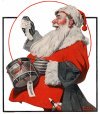 Norman Rockwell Santa Claus Gallery is open! |







Images are copyrighted by their respective copyright holders.
Graphic Files Protected by Digimarc.
Contact us for details about using our articles on your website.
The only requirements are an acknowledgement and a link.


Sitemap | Sitemap, 2 | Sitemap, 3 | Sitemap, 4 | Privacy Policy | Disclaimer |

