|
|||||||||||||||||||
The Departing Maid by Norman Rockwell
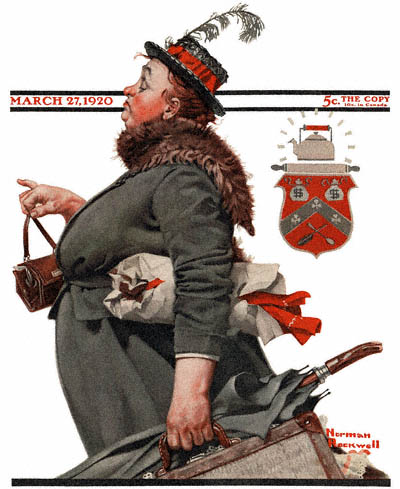
March 27, 1920 Issue of The Saturday Evening PostThe Departing Maid, this Norman Rockwell painting, appeared on the cover of The Saturday Evening Post published March 27, 1920. This painting was Rockwell's twenty-eighth overall picture out of 322 featured on the cover of The Post. Rockwell's career with the Post spanned 47 years, from his first cover illustration, Boy With Baby Carriage in 1916 to his last, Portrait of John F. Kennedy, in 1963. It is also the third Rockwell cover in 1920. The Post featured a Rockwell illustration on its cover eleven times in 1920. The location of the original painting is not known. This illustration has been reproduced in three Rockwell commentary books, on page 127 of The Norman Rockwell Album, as illustration 145 of Norman Rockwell: Artist and Illustrator by Thomas Buechner and on page 82 of Norman Rockwell, A Definitive Catalogue by Laurie Norton Moffatt. It is rare to find an early Rockwell Post cover, such as this one, in excellent condition. Expect to pay a premium for an original cover in top condition.
The Departing MaidGiclee Prints on Archival Paper: With this illustration, Norman Rockwell give us a glimpse at a servant to the wealthy. This maid has just finished her shift. She works at the home of some wealthy folks. At least that is what her coat of arms implies. See the money bags prominently displayed. The money bags are only slightly less prominent than the tea kettle and rolling pin. She apparently considers herself somewhat upper-crust also. Her manner in general and the tilt of her head in particular suggest that she may consider herself superior to her peers. She is stocky and somewhat heavyset. She wears nice clothes. Her attire suggests style and presence. The tall feather on her hat could not be pulled off by just anyone. The Departing Maid was only one of 322 Norman Rockwell Saturday Evening Post covers; Here is the list of Norman Rockwell Saturday Evening Post cover illustrations.
Here is the complete list of all Norman Rockwell magazine covers. She wears a fox fur scarf. Also keeping her warm is her heavy wool jacket and skirt. Generally speaking, she is a lady who works for a lady. The final and most important pointer to that conclusion is the way she carries her purse. In the final assessment, as Rockwell visually points out, the true mark of a gentleman or lady is really found between the ears.
(Image Only) Copyright © 1920 Saturday Evening Post & Curtis Publishing Company
Remember to check back often.
|
Norman Rockwell Quotes:I'll never have enough time to paint all the pictures I'd like to. No man with a conscience can just bat out illustrations. He's got to put all his talent and feeling into them! Some people have been kind enough to call me a fine artist. I've always called myself an illustrator. I'm not sure what the difference is. All I know is that whatever type of work I do, I try to give it my very best. Art has been my life. Right from the beginning, I always strived to capture everything I saw as completely as possible. The secret to so many artists living so long is that every painting is a new adventure. So, you see, they're always looking ahead to something new and exciting. The secret is not to look back. I can take a lot of pats on the back. I love it when I get admiring letters from people. And, of course, I'd love it if the critics would notice me, too. You must first spend some time getting your model to relax. Then you'll get a natural expression. More at BrainyQuote. Rockwell Favorites
|
||||||||||||||||||
|
|
|||||||||||||||||||
|
Images are copyrighted by their respective copyright holders. Graphic Files Protected by Digimarc. Contact us for details about using our articles on your website. The only requirements are an acknowledgement and a link.  
|
|||||||||||||||||||