|
||||||||||||||
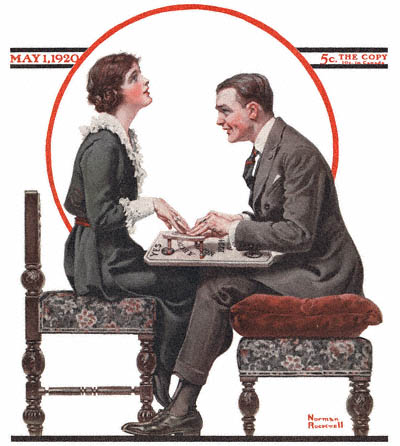
The Ouija Board by Norman RockwellMay 1, 1920 Issue of The Saturday Evening PostThe Ouija Board, this Norman Rockwell painting, appeared on the cover of The Saturday Evening Post published May 1, 1920. This painting was Rockwell's twenty-ninth overall picture out of 322 total featured on the cover of The Post. Rockwell's career with the Post spanned 47 years, from his first cover illustration, Boy With Baby Carriage in 1916 to his last, Portrait of John F. Kennedy, in 1963. This was also the fourth Rockwell cover in 1920. The Post featured a Rockwell illustration on its cover eleven times in 1920. The original oil on canvas painting, 26 x 22 inches or 66 x 56 cm, is part of a private collection. This painting also appears in three Rockwell commentary books. It appears as illustration 94 of Norman Rockwell's America by Christopher Finch, as illustration 130 of Norman Rockwell: Artist and Illustrator by Thomas Buechner and on page 82 of Norman Rockwell, A Definitive Catalogue by Laurie Norton Moffatt. Pristine examples of this cover regularly sell for more than one hundred dollars. And to think it only cost five cents when brand new.
The Ouija BoardGiclee Prints on Archival Paper: In this painting, Norman Rockwell gives us a look at both the seriousness and the trivial side of the occult. Here we see a couple asking questions of an Ouija board. Ouija boards are also called talking boards and spirit boards. This device is used to ask questions of spirits. The spirits are supposed to guide the participants' hands on the part of the ouija board set that moves, the planchette. This guidance produces the spirits' answers to asked questions. One person can use a talking board, but is supposedly more accurate with two people. This is especially true when the answer concerns the two people asking. The Ouija Board was only one of 322 Norman Rockwell Saturday Evening Post covers;
Here is the list of Norman Rockwell Saturday Evening Post cover illustrations.
Here is the complete list of all Norman Rockwell magazine covers. We do not know what questions the couple is posing to the spirits. But we can observe that the young man is pushing the planchette towards "YES". He is watching the young woman to make sure she doesn't spy him influencing the spirits' answer. The young woman is not looking at the board or the planchette. She is gazing upwards. She is hoping to get an answer from spirits. The young man wants a specific answer. I wonder what the question is.
(Image Only) Copyright © 1920 Saturday Evening Post & Curtis Publishing Company
Remember to check back often.
|
Norman Rockwell Quotes:I'll never have enough time to paint all the pictures I'd like to. No man with a conscience can just bat out illustrations. He's got to put all his talent and feeling into them! Some people have been kind enough to call me a fine artist. I've always called myself an illustrator. I'm not sure what the difference is. All I know is that whatever type of work I do, I try to give it my very best. Art has been my life. Right from the beginning, I always strived to capture everything I saw as completely as possible. The secret to so many artists living so long is that every painting is a new adventure. So, you see, they're always looking ahead to something new and exciting. The secret is not to look back. I can take a lot of pats on the back. I love it when I get admiring letters from people. And, of course, I'd love it if the critics would notice me, too. You must first spend some time getting your model to relax. Then you'll get a natural expression. More at BrainyQuote. Rockwell Favorites
|
|||||||||||||
|
|
||||||||||||||
|
Images are copyrighted by their respective copyright holders. Graphic Files Protected by Digimarc. Contact us for details about using our articles on your website. The only requirements are an acknowledgement and a link.  
|
||||||||||||||